The full playbook stays readable either way.
Licensed through your school? Sign in here
Mindset
Fixed vs. Growth Mindset
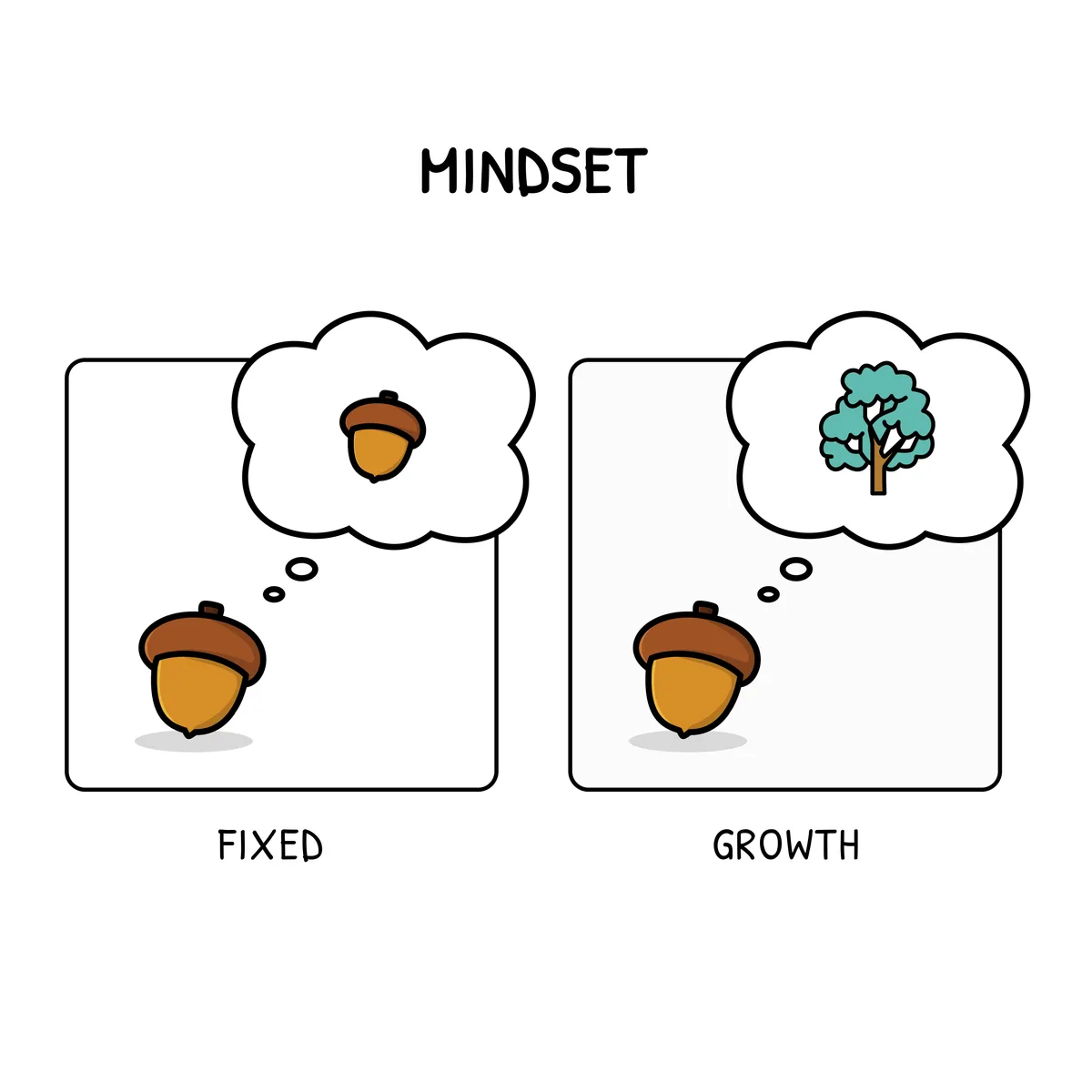
The acorn is the same. The thought bubble is everything.
Student outcome focus
Students identify the difference between fixed and growth mindset beliefs, recognize these patterns in their own thinking, and understand that mindset itself is something that can be shifted.
Discussion questions
Look at the two acorns. What is different between them? What is exactly the same?
Grades 3-5
The acorn on the right is imagining becoming a big oak tree. What is something you have imagined yourself becoming that you are not yet?
Grades 4-6
Have you ever told yourself "I am just not good at this"? What would the growth mindset version of that same thought sound like?
Grades 5-7
There are more than these three. In the full collection you set your grade and the right questions load for you automatically. All of them, for every grade, are in the Adapt it tab below and in the playbook.
In advisory / homeroom
Tips from the classroom
- Introduce "fixed acorn / oak acorn" as classroom shorthand. Students can self-report without explaining: "I am in the fixed acorn mindset about this topic right now." This creates a low-stakes way to name a fixed mindset moment without shame.
- When a student says something fixed ("I'm terrible at this," "I'll never get it"), gently ask: "Which acorn is that?" This redirects without correcting and builds metacognitive habit over time.
- Ask students to keep a mindset journal for one week. Each day they record one moment when they were in the fixed acorn mindset and one moment when they shifted to the oak mindset. Debrief as a class: what caused the shift?
- Pair this visual with Your Brain Believes What You Repeat to show what the oak acorn mindset produces in outcomes.
- Use this one first to establish the belief, then Your Brain Believes What You Repeat to show the result.
- Use as a pre-assessment at the start of a unit: "Which acorn describes how you feel about this topic right now?" Track responses anonymously and use the data to differentiate support throughout the unit.
- For older students, extend the metaphor: an acorn does not become an oak in one season. "What are the seasons your oak tree will need to grow through? What does each one require of you?"
More on the idea
What you believe about your potential shapes whether you ever reach it.
Two acorns. Same seed. Same starting point. Same everything, except the thought bubble. One acorn sees an acorn. The other sees an oak. Which acorn are you today? And which do you want to be? Common acorn: it sees what it is and calls it a ceiling. Growth mindset acorn: same seed, same ground, but it looks up. Be the oak.
Questions by grade
Look at the two acorns. What is different between them? What is exactly the same?
Grades 3-5
The acorn on the right is imagining becoming a big oak tree. What is something you have imagined yourself becoming that you are not yet?
Grades 4-6
Have you ever told yourself "I am just not good at this"? What would the growth mindset version of that same thought sound like?
Grades 5-7
Fixed mindset says "I am what I am." Growth mindset says "I am what I practice." Which one feels more true to you right now, and about which parts of your life?
Grades 6-9
Can a person have a growth mindset in some areas and a fixed mindset in others at the same time? Give a real example from your own life.
Grades 8-10
Why might a fixed mindset feel safer or more comfortable than a growth mindset? What does staying fixed protect a person from?
Grades 9-12
College is often the first time people encounter a subject they are genuinely not naturally good at. How do you respond when that happens -- do you find yourself moving toward the oak or staying at the acorn? What would it take to shift that?
College / Univ.
By language level
- WIDA Levels 1-2 (Entering / Emerging)
- Point to the fixed acorn, then the oak acorn. Ask: "Which one is you right now?" Students respond by pointing or gesturing. No language needed. The image communicates the full contrast without a single word.
- WIDA Level 3 (Developing)
- Use frames: "The acorn on the left thinks ___." / "The acorn on the right thinks ___." / "I am more like the ___ acorn because ___." Students speak or write one sentence per acorn.
- WIDA Levels 4-5 (Expanding / Bridging)
- Discuss: "Describe a time you had a fixed mindset about something. What changed your thinking, or what would have needed to change it?" Students write a paragraph or share with a partner. Visual Advantage for ELL Students: The acorn-to-oak metaphor is recognized across cultures as a symbol of potential. The side-by-side format makes the comparison immediately visible with no English required. This is one of the most accessible visuals in the series for newly arrived students.
In other settings
- Advisory / Homeroom
- Use at the start of the year to establish shared mindset language. Ask students to draw their own two acorns: "What is your acorn right now, and what is your oak tree?" Post on the wall as a reference point throughout the year. Return to the image whenever a student says "I can't do this."
- School Counseling
- Use with students who express helplessness or self-limiting beliefs. The fixed acorn makes the belief visible and nameable: "That sounds like the fixed acorn. What would the oak acorn sound like?" This creates distance from the belief without dismissing the student's experience.
- SPED / Resource Room
- For students with IEP goals around self-efficacy or academic self-concept, the two acorns give a concrete anchor for the difference between "I cannot" and "I cannot yet." Pair with specific examples from the student's own work where growth has already happened, even in small increments.
- ELL Classroom
- Use to validate students who are early in English acquisition: "You are already the oak acorn. You are already growing your tree." This reframe is especially powerful for students who feel stuck or behind because of language barriers, helping them separate language development from intellectual identity.
- Higher Ed / University
- Use in college success courses, academic coaching sessions, or with students who have just encountered a subject they are genuinely struggling with for the first time. The acorn metaphor opens a conversation about what their abilities actually are versus what they currently look like.
CASEL social and emotional learning1
- Self-Awareness
- The core competency of self-awareness includes recognizing how one's beliefs about oneself shape behavior and outcomes. The acorn visual makes this abstract concept concrete: students can see two different self-images and ask themselves which thought bubble looks more like their own.
- Self-Management
- Carol Dweck's research shows that fixed mindset equates current ability with permanent identity, while growth mindset treats current ability as a starting point. The visual translates this research into a single image students can internalize, return to, and use to self-regulate their response to challenge.
Universal Design for Learning (UDL)
- Multiple Means of Representation
- The visual communicates entirely through image and position, requiring no reading. The acorn-to-oak progression is understood across languages and cultures as a symbol of potential and growth. Students at every literacy level access the same concept simultaneously.
- Multiple Means of Engagement
- The side-by-side format invites immediate self-identification: "Which acorn am I today?" This personal resonance creates engagement across a wide developmental range, from concrete thinkers in Grade 3 to students in Grade 12 exploring the systemic implications of fixed versus growth beliefs.
WIDA language development
- Levels 1-5 Scaffolded Access
- At Levels 1-2, students point to the acorn they identify with and respond with a gesture. At Level 3, sentence frames introduce the language of mindset. At Levels 4-5, students write or discuss the implications of each mindset for their academic and personal goals.
Multi-Tiered System of Supports (MTSS)
- Tier 1 Universal / Tier 2 Targeted
- As a Tier 1 anchor, this visual opens the conversation about learning beliefs for an entire class or school. At Tier 2, it supports students with IEP goals around self-efficacy or anxiety about failure, providing a non-threatening way to examine and name limiting beliefs.
What you teach on Tuesday lands harder when it gets mentioned at home on Tuesday night. The Parent Kit gives every visual a ready line for your weekly email, plus slides for back-to-school night and half-sheets for conferences.
Get the collectionGoes well with
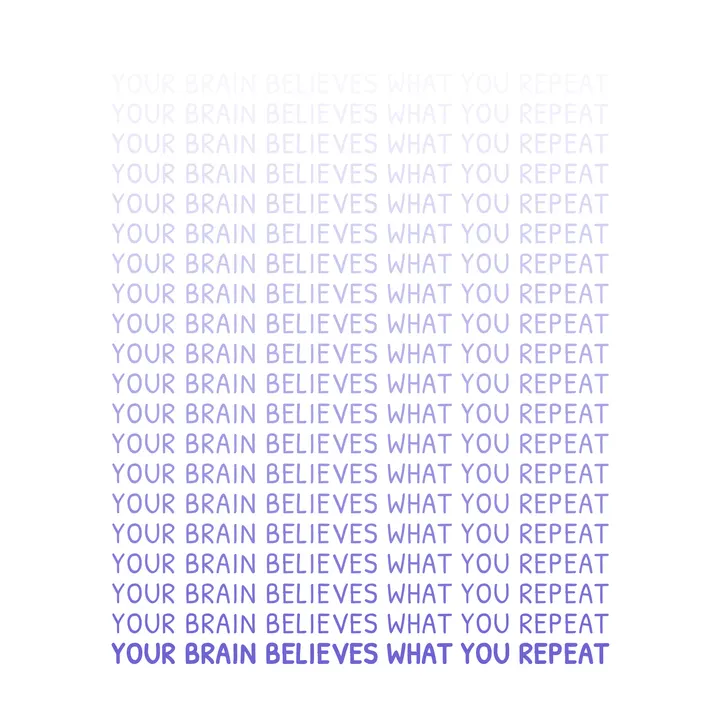
Your Brain Believes What You Repeat
For students who embrace growth mindset but are looking for what to actually do with it, this visual might be a grounding next step. The answer being: repeat the belief until the brain accepts it as true.