The full playbook stays readable either way.
Taking Action
Good Before Great
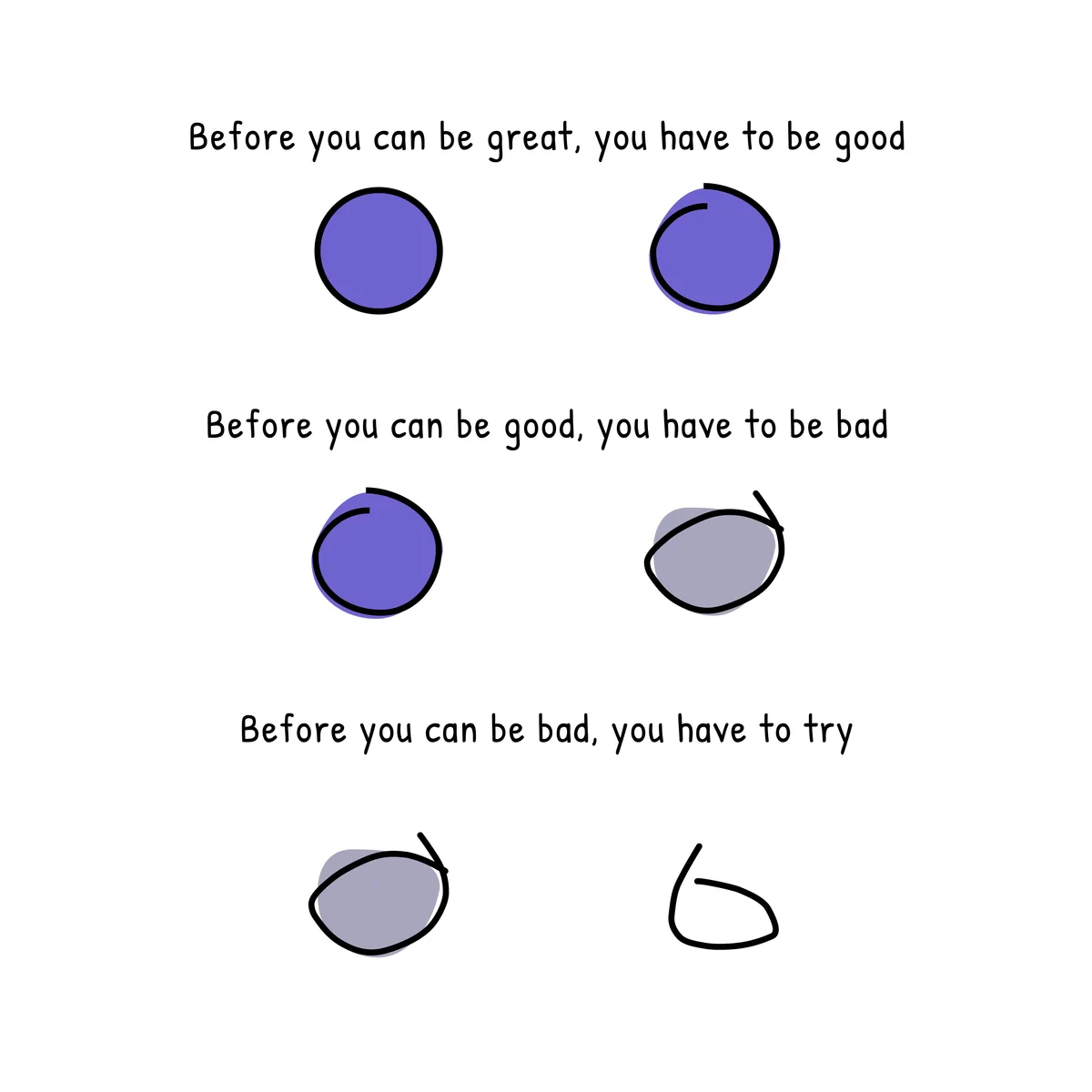
You cannot skip to great. Every stage in the chain must be earned, and earning starts with a try.
Student outcome focus
Students locate themselves within a visible progression from attempt to excellence, removing the belief that greatness requires a different starting point and replacing it with the understanding that their current attempt is already the correct first step.
Discussion questions
Look at the three rows of circles. What is happening to them as you read from the bottom to the top? What do the circles represent?
Grades 3-5
Have you ever been bad at something that you are now good at? What did the "bad" stage feel like when you were in it?
Grades 4-6
The visual says you have to try before you can be bad. What does it mean that "trying" comes before "bad" in the chain? Why is that important?
Grades 6-8
There are more than these three. In the full collection you set your grade and the right questions load for you automatically. All of them, for every grade, are in the Adapt it tab below and in the playbook.
In advisory / homeroom
Tips from the classroom
- At the start of any new unit or skill, ask students to draw their circle and fill it to show their current level. No grades, no sharing required. The act of locating themselves on the chain reduces the anxiety of starting.
- Use the language of the chain throughout the year.
- When a student says they are bad at something, respond: "You are exactly where you need to be in the chain. What would one try look like today?" Post the visual in a shared space and periodically ask students to update their circle fill. Making progression visible over time reinforces that movement through the chain is real and trackable. Connect the chain to a specific skill the class is developing together, whether writing, a sport, an instrument, or a subject. Naming the whole class's collective position on the chain normalizes the stage.
- For students who compare themselves to peers, ask them to identify which circle that peer was at when they first started. This disrupts the comparison by reintroducing the full chain.
- Pair with a brief reflection at the end of a unit: "Which circle did you start in? Which circle are you in now? What moved you?" This makes growth visible and attributable to effort.
More on the idea
You cannot skip to good. You have to earn bad first, and bad starts with a try.
Three rows, each a pair of circles. Top row: two purple circles, greatness. Middle row: two blue circles, the good stage. Bottom row: a blue and a grey circle, bad. Then one grey circle alone, the try. The chain runs one direction. The only entry point is at the bottom.
Questions by grade
Look at the three rows of circles. What is happening to them as you read from the bottom to the top? What do the circles represent?
Grades 3-5
Have you ever been bad at something that you are now good at? What did the "bad" stage feel like when you were in it?
Grades 4-6
The visual says you have to try before you can be bad. What does it mean that "trying" comes before "bad" in the chain? Why is that important?
Grades 6-8
Think about something you are currently in the "bad" stage of. Knowing that bad comes before good, does that change how you feel about where you are?
Grades 7-9
We often compare ourselves to people who are already at the "great" level. How does looking at the full chain change what a fair comparison looks like?
Grades 9-12
University culture often only celebrates the "great" circle and treats the "bad" and "try" stages as things to hide. What does that culture cost students who are still in the middle of the chain?
College / Univ.
By language level
- WIDA Levels 1-2 (Entering / Emerging)
- Point to the circle that shows where you are right now with this skill. Draw your own fill in an empty circle. No words required. The circles are the communication.
- WIDA Level 3 (Developing)
- Use frames: "Right now I am in the ___ stage." / "I got to the good stage when I ___." / "The next stage for me is ___."
- WIDA Levels 4-5 (Expanding / Bridging)
- Discuss: "Describe a time you moved from one stage to the next. What caused the shift?" Students write a short reflection naming their current stage in two different areas of their life and what moving to the next stage might require.
In other settings
- Advisory / Homeroom
- Use at the start of a new year, semester, or unit. Ask students to identify one skill they want to develop and draw their circle fill for where they currently are. Post the circles on a shared wall and return to them at the end of the term to show the progression.
- School Counseling
- Use with students who are avoiding a task because they feel they are not good enough yet to begin. The chain shows that "bad" is not a failure state; it is a required stage. Ask: "Which circle are you at right now, and what would one try look like?"
- SPED / Resource Room
- For students with IEP goals around skill development, map the circle chain onto a specific target skill. Define what "trying," "bad," "good," and "great" look like for that skill concretely. Use the circles as a progress monitoring tool across the term.
- ELL Classroom
- Use the circles to normalize language acquisition as a progression rather than a binary. Students who feel "bad" at English are already in the correct stage of the chain. Reference the visual when students apologize for imperfect language: "You are in the good stage. That is exactly where you should be."
- Higher Ed / University
- Use in first-year advising, academic support, or any setting where students are comparing themselves to peers who appear more advanced. The chain makes visible what those peers do not show: every great student passed through the bad and try stages first.
CASEL social and emotional learning1
- Growth Mindset
- The three-row progression dismantles the belief that excellence requires a different starting point. By making the empty circle at the bottom of the chain the required first step, the visual repositions trying as the legitimate beginning of greatness, not a lesser alternative to it.
- Self-Management
- Students learn to locate themselves within a visible progression rather than measuring themselves against the endpoint. When the feeling of being bad at something arises, the visual provides a framework for recontextualizing that feeling as evidence of being in the correct place on the chain.
Universal Design for Learning (UDL)
- Multiple Means of Representation
- The circle fill progression communicates competence without words. Students who struggle with reading or abstract language access the entire concept through the visual gradient from empty to full. The structure is legible at a glance before any text is processed.
- Multiple Means of Action and Expression
- Ask students to draw their own circle for a current skill or subject and fill it to match where they think they are in the chain. This transforms the visual into a self-assessment and goal-setting tool that requires no writing and can be completed in under two minutes.
WIDA language development
- Levels 1-5 Scaffolded Access
- At Levels 1-2, students point to the circle that represents their current skill level and draw their own fill. At Levels 3-4, sentence frames guide participation: "I am in the ___ stage because ___." At Level 5, students discuss the chain using subject-specific examples and academic vocabulary.
Multi-Tiered System of Supports (MTSS)
- Tier 1 Universal / Tier 2 Targeted
- As a Tier 1 tool, this visual works in any setting where students are beginning a new skill or subject. At Tier 2, counselors and resource teachers use it with students who avoid starting because they compare their current "bad" stage to peers who appear to already be "good."
What you teach on Tuesday lands harder when it gets mentioned at home on Tuesday night. The Parent Kit gives every visual a ready line for your weekly email, plus slides for back-to-school night and half-sheets for conferences.
Get the collectionGoes well with
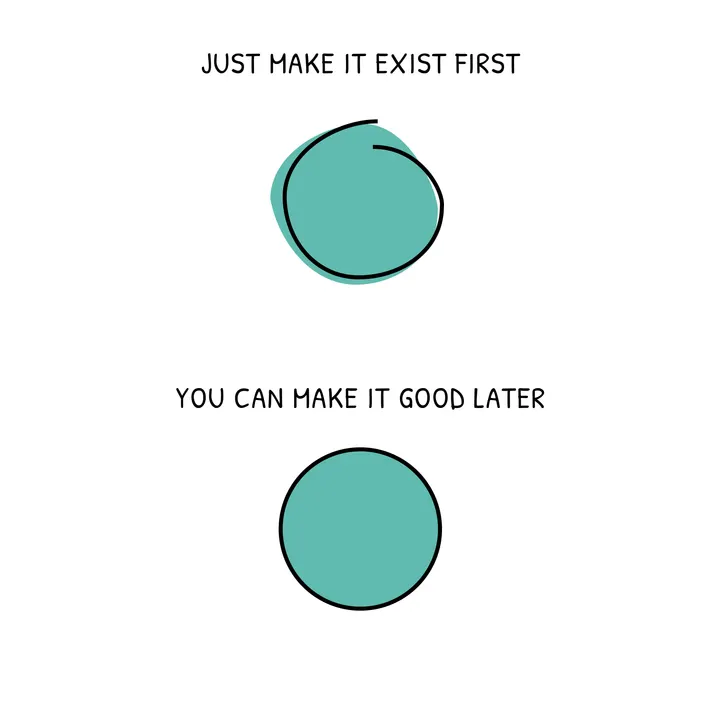
Just Make It Exist First
If students understand the chain but still cannot start the try stage, this visual addresses the same block. The try stage and the rough circle are the same first move described two different ways.
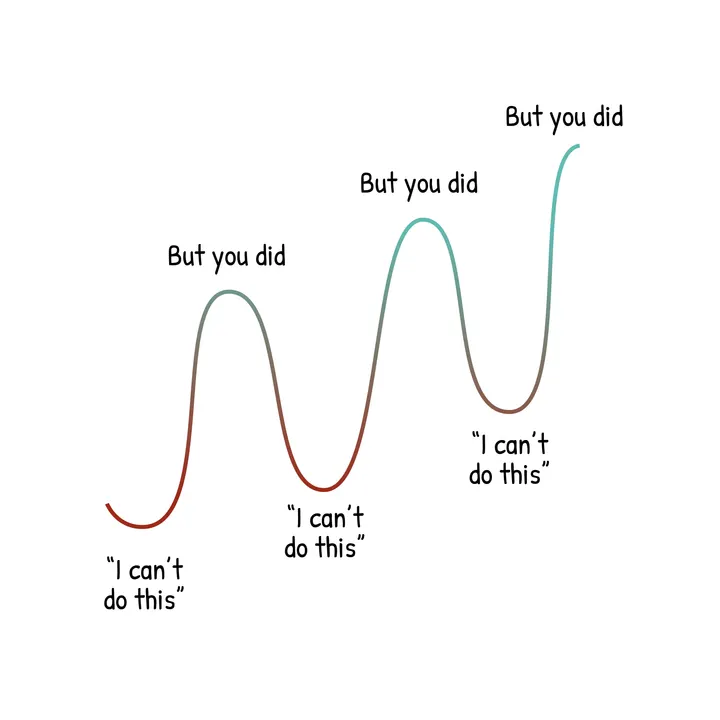
I Can't Do This, But You Did
For students who want to understand why the bad stage feels so impossible in the moment, this visual shows the emotional reality of moving through it. The trough is the mechanism that drives movement up the chain.